
Untangling the Fear around Nuchal Cords
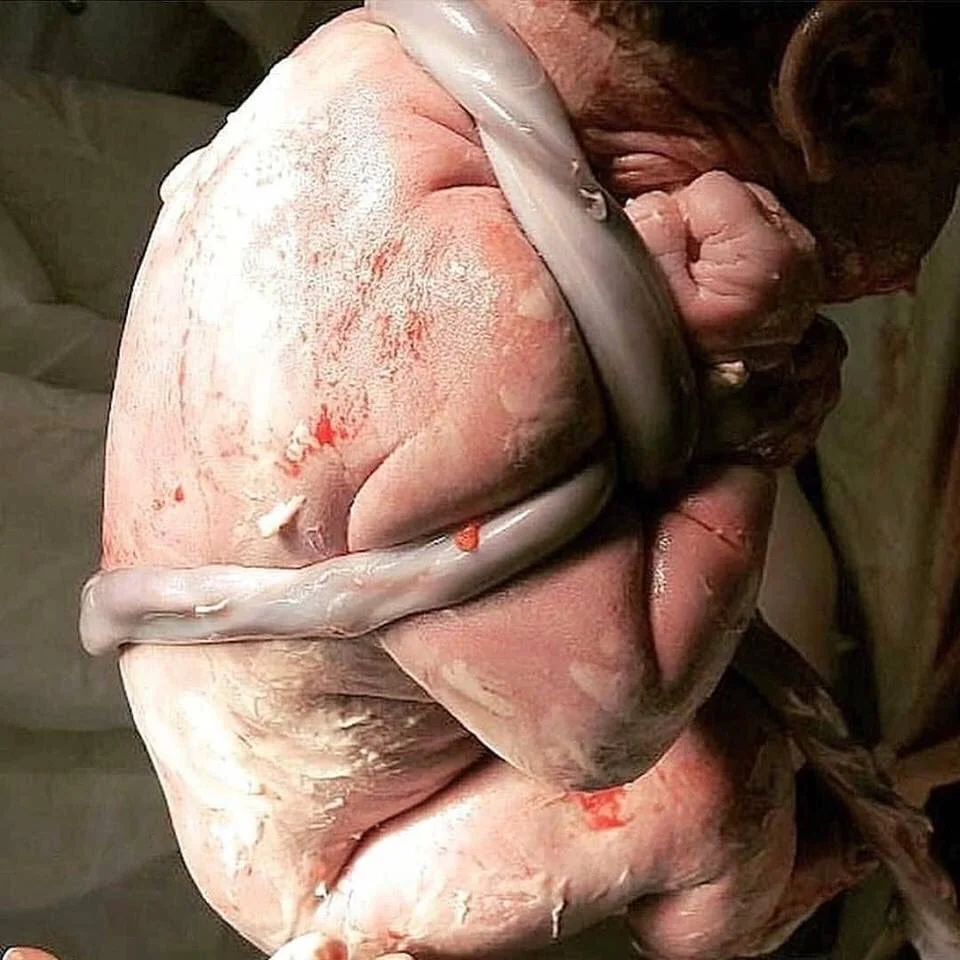
What you were never told about the cord around your baby's neck
By Kristen Nagle | Former NICU Nurse · Founder, Reclaiming Birth Gathering
The cord was around her baby's neck.
That's what went in the chart. That's what the care provider pointed to. That's what she carried home — along with her baby, her questions, and a story about her body that she wasn't sure she believed but didn't know how to challenge.
If this is your story, keep reading.
Because what most women are told about the nuchal cord is incomplete at best, and harmful at worst. And the piece that's almost always missing from the conversation is the most important part of all.
First — the number that changes everything
One in three babies is born with the cord around their neck.
Thirty percent of all births. Let that sink in. If the nuchal cord were truly the emergency it's been framed as — if it genuinely cut off oxygen and caused the outcomes it so often gets blamed for — we would have an undeniable, catastrophic crisis in maternity care. Globally. Historically. Across every culture and every century of human birth.
We don't.
Because a nuchal cord is not a complication. It is a variation of normal. It has always been a variation of normal. And the fear built around it has caused more harm than the cord itself ever has.
The most important thing nobody tells you: babies don't breathe through their throat
Here is the piece of information that reframes this entire conversation — and that is almost never included in the nuchal cord discussion.
While your baby is inside the womb, they do not breathe through their trachea the way you are breathing right now as you read this. They practice using their lungs by swallowing amniotic fluid. Their airway is not yet their lifeline.
Their cord is.
Every molecule of oxygen. Every nutrient. Everything required for your baby's survival flows from the placenta, through the umbilical cord, to the baby. Not through their throat. Not through their airway.
This means that the cord being around a baby's neck — even a relatively snug one — does not cut off their oxygen supply in the way we have been conditioned to fear. The cord is the oxygen supply. It remains attached to the placenta. It continues to pulse and deliver throughout the entire birth process.
Understanding this changes everything about how we interpret the nuchal cord.
What the cord is actually built to do
The umbilical cord is not fragile. It is not a delicate thread that can be easily compressed or kinked into danger. It is a purposefully, intelligently designed structure — built for exactly the life it lives.
Wharton's jelly. The cord is coated in a thick, protective gelatinous substance that cushions the three blood vessels inside from the compression and stretching involved in being tethered to a moving baby for nine months. This cushioning does not disappear during birth. It is present throughout.
Coiled like a telephone wire. The cord is naturally coiled — giving it flexibility, stretch, and recoil. It is designed to accommodate movement without compromising flow.
Long enough for the job. The average cord is 55 centimetres. Long enough to wrap around a neck, a torso, a limb — and still have the length and slack needed to function exactly as it was designed to.
Babies with longer cords are understood to wrap themselves. This is thought to be a self-protective behaviour — a way of organising the cord to prevent prolapse, a situation where the cord would descend ahead of the baby. The cord around the neck is not evidence of something going wrong. In many cases, it is evidence of something going right.
How birth actually works with a nuchal cord
One of the most persistent fears is this: if the cord is around the baby's neck, won't it pull tighter as the baby descends? Won't it hold the baby back?
Here is the physiology.
During birth, the baby, the uterus, and the placenta all move downward together. They are one interconnected system making one coordinated descent. The baby is not being pulled in one direction while something attached to it pulls in another. Everything moves together.
In the vast majority of cases, a nuchal cord requires nothing to be done. As the baby is born, they rotate and somersault through — and the cord unloops naturally. Birth continues exactly as it was designed to.
The presence of a nuchal cord, on its own, is not a reason to intervene. It is not a reason to reach in and manipulate the cord. It is not a reason to change the course of a birth that is progressing normally.
Where the fear comes from — and why it matters
Sometimes, babies do not make it before they are born. With no explanation that anyone can find. This is incredibly tragic and a heart wrenching situation for any parent. Absolutely unimaginable and a parents worst nightmare. When these babies arrive, they are sometimes — like a third of all babies — found with the cord around their neck. And in the absence of another answer, the cord receives the blame.
This is not a small thing. The story we build around loss shapes grief, shapes protocol, shapes how every subsequent birth is managed. Grief became fear. Fear became standard practice. Standard practice became the reason your care provider's posture changes when they see the cord at the head.
When a c-section is performed for "fetal distress" or "failure to progress," the presence of a nuchal cord is frequently cited as a contributing factor — sometimes as the reason. Also, not enough education and awareness is discussed about synthetic labour using pitocin,that causes mechanical contractions that can be very hard on the baby. When outcomes are poor, the cord becomes the explanation on the chart.
Whether or not the cord caused the outcome.
I say this not to remove accountability from where it belongs, but to name something clearly: the story told about a birth — especially a difficult one — shapes how a mother understands her own body for the rest of her life. Getting that story right matters, for herself, her children and for future mothers and families. So we can do better.
When intervention creates the emergency
Very occasionally, in the final moments of birth as the head is emerging, a cord will become genuinely stretched or tight against the baby's body or the mother's pelvis. This is real. It happens.
What happens next determines everything.
A skilled, calm, knowledgeable care provider can support this situation without cutting the cord. Without clamping. Without severing the baby's lifeline before the body is born. There are techniques — and experienced hands know them.
But when a care provider — out of fear, out of protocol, out of a sincere but misplaced urgency — reaches in to unhook the cord before it is necessary, or cuts and clamps the cord before the baby's body has been born, they interrupt the oxygen supply at the very moment the baby is transitioning from cord-dependent to air-breathing.
The cord was not the problem. The removal of the cord before the transition was complete — that is where the emergency begins.
The cord after birth — the piece almost no one talks about
The conversation about the nuchal cord almost always stops at birth. It shouldn't.
After your baby is born, the cord should remain intact. Still attached to the placenta. Still pulsing.
Here is why this matters so profoundly.
Your baby has just completed the most dramatic physiological transition of their entire life. For nine months, every breath — every molecule of oxygen — came through the cord. Now they must shift to using their lungs and breathing air. This transition does not happen in a moment. It happens over minutes. And while it happens, the cord continues to pulse — continuing to deliver blood, oxygen, and stem cells from the placenta to the baby.
The pulsing cord is the bridge between the life your baby lived inside the womb and the life they are beginning outside of it. It is not a redundant structure to be quickly disposed of. It is an active, purposeful, essential part of how your baby arrives safely in the world.
When the cord is cut immediately after birth — before it has stopped pulsing, before that transition is complete — we interrupt one of the most important physiological processes in a new human being's life.
Delayed cord clamping is not a birth preference. It is not a natural birth trend. It is physiology. It is what the body is designed to do when left undisturbed.
For the mother carrying this
If you were told the cord around your baby's neck caused the emergency — you deserved more information than that.
If the cord was used to explain an intervention you didn't fully understand, didn't fully consent to, or have never been able to make peace with — you deserved the full picture.
If you've spent time since your birth wondering whether your body failed, whether you should have done something differently, whether the cord was a sign that something was wrong with you or your baby — I want you to hear this clearly:
Your body was not failing. Your baby was not in danger from the cord. You were not given the truth.
And knowing that changes something. Not to erase what happened. Not to rewrite your birth. But because how we understand our bodies shapes how we live in them. How we understand our births shapes how we enter the next season — whether that's another pregnancy, another birth, or simply the life we're living right now.
This is the education birth deserves
This is what should be taught in every prenatal class, every midwifery program, every birth preparation space. It isn't. Not yet — not widely enough.
But it's the foundation of everything we do at Reclaiming Birth Gathering.
We gather every year because this information changes lives. Because a woman who understands her body enters birth differently. Because a care provider who trusts physiology over fear makes different decisions in the room. Because families who come together around the truth of how birth works — leave different.
Reclaiming Birth Gathering — September 10–12, 2026 · Caledon, Ontario.
Year 4. Mothers, fathers, birth workers, and families coming home to what birth was always meant to be.
[Get your tickets → reclaimingbirthgathering.com]
Share this post with a mother who needs it. Save it for a friend who's pregnant. The cord is not the enemy. It never was.
About Kristen Nagle
Kristen is a former NICU nurse turned birth advocate, speaker, and founder of Reclaiming Birth Gathering — an annual family gathering in Ontario dedicated to restoring trust in physiological birth. She writes at kristennagle.ca and lives faithfully fearless with her family.
Follow: @kristen_nagle · @reclaimingbirthgathering
disclaimer this is not health or medical advice, this is for educational purposes only. Please do your own research and due diligence.